Friday, February 4, 2022

Adding Private Banks to the Mechanical Exercise

This is a follow-on for the recent post "A Mechanical Exercise Tracking the Creation and Lifespan of Fiat Money" (METC). In the original exercise, the user made all of the economic decisions. Private banks were money users. In this post, we introduce private banks into the role of decision-making for the process of creating money.
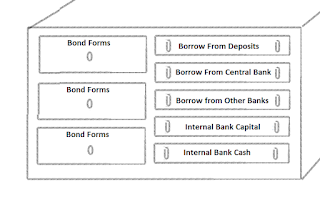
Figure 1. The raw material for money
creation by private banks.
In METC, we needed a virtual storehouse to store real tokens that we could later call "money". Here we introduce a private bank's version of a virtual storehouse which is, of course, real all the time.

In the drawers of this new storehouse (Figure 1), we have existing money sources that the banks can use to ensure that new borrowers have access to existing money. So how is it that new fiat money can be created in this new version of METC? Private banks take systematic advantage of the pool of money on deposit by making a loan without linking loan risk or deferred spending to any one account. The loan is made by creating a deposit account for the borrower. Loan risk is spread to the entire body of depositors, including the lending bank. Deferred spending is transformed into accelerated spending. As a result of the loan, the amount of money on deposit in the banking system is measured as increasing. *

Saturday, January 22, 2022

Money is Not an IOU, It's More Like a Ticket

In this post, we ask the question "What is money?".  Mike King, in a series of posts beginning with "1. Defining "money"", starts us off along one path. To him, money is an IOU and the market has an obligation to those owning IOUs because these owners have done prior work.

Our analysis takes us in a different direction. Money is not an IOU, it's more like a ticket. This analogy makes sense because ownership of a ticket entitles the owner to privileges equal to those enjoyed by all other owners of similar tickets.

Now we need to justify this argument:

Sunday, December 26, 2021

A Mechanical Exercise Tracking the Creation and Lifespan of Fiat Money

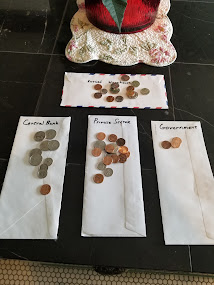
Here's a little mechanical exercise that tracks the creation and lifespan of fiat money. We use coins to identify paper or electronic financial instruments and the backs of used envelopes to represent sectors which own financial wealth. This exercise should be comforting for those who believe that money might have a physical reality but may seem unrealistic to those who think of money as being purely virtual.

Our stock of coins should include at least three different denominations. We need four envelopes to represent three financial sectors of an economy and a virtual storehouse.

I used quarters, dimes and pennies. Quarters were used as government bonds, dimes as mortgage-backed securities, and pennies as fiat money.